
Healtius

Robotergestützte Haartransplantation

Anfrage erstellen

Die robotergestützte Haartransplantation ist ein hochmodernes, minimalinvasives Verfahren zur Haarwiederherstellung, bei dem mithilfe fortschrittlicher Robotertechnologie Haarfollikel entnommen und in die kahlen Bereiche verpflanzt werden. Diese Technik bietet Präzision, eine kürzere Heilungszeit und weniger Beschwerden im Vergleich zu herkömmlichen Haartransplantationsmethoden.
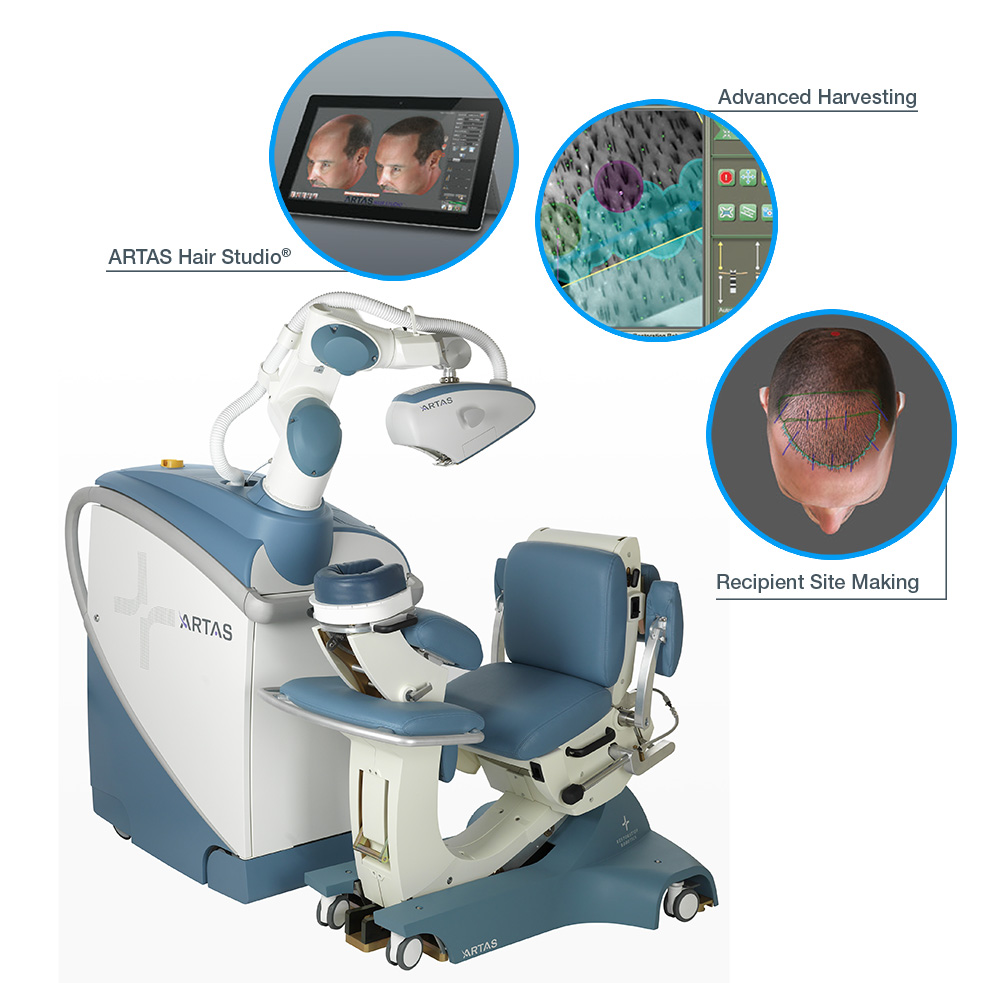
Robotergestützte Haartransplantation

Allgemein

Bei der Roboter-Haartransplantation wird das ARTAS-System verwendet, ein ausgeklügeltes Robotergerät, das speziell für die Haarwiederherstellung entwickelt wurde. Die Technologie ermöglicht es Chirurgen, Haarfollikel mit präziser Kontrolle und Genauigkeit aus dem Spenderbereich, in der Regel dem Hinterkopf, zu entnehmen, der in der Regel resistent gegen Glatzenbildung ist. Diese Follikel werden dann in den Empfängerbereich transplantiert, in dem das Haar dünner wird oder kahlköpfig wird, wodurch natürlich aussehende Ergebnisse erzielt werden. Der Einsatz von Robotik ermöglicht höhere Transplantatüberlebensraten, schnellere Eingriffe und minimiert menschliche Fehler, wodurch der Prozess im Vergleich zu manuellen Techniken effizienter und effektiver wird. Aufgrund des minimalinvasiven Verfahrens können die Patienten mit einer schnelleren Erholungsphase, minimaler Narbenbildung und einem geringeren Komplikationsrisiko rechnen. Hinzu kommen die ästhetischen Vorteile einer volleren Haarpracht.

Besondere Details

Who is it for?

    Personen mit mäßigem bis schwerem Haarausfall

    Kandidaten mit ausreichender Haardichte im Spenderbereich

    Menschen, die nach einer minimalinvasiven Lösung gegen Haarausfall suchen

    Personen, die präzise und technologisch fortschrittliche Behandlungsmöglichkeiten bevorzugen

Recovery Period

    Das Verfahren dauert in der Regel 4-8 Stunden, abhängig vom Ausmaß des Haarausfalls

    Die Erholungszeit ist relativ kurz, und die meisten Patienten kehren innerhalb weniger Tage zu ihrer Routine zurück

    Vollständige Erholung und Haarwachstum können innerhalb von 6 bis 12 Monaten nach dem Eingriff festgestellt werden

Potential Risks and Side Effects

    Vorübergehendes Taubheitsgefühl oder Unwohlsein in den behandelten Bereichen

    Infektionsrisiko, obwohl aufgrund der Präzision und Sauberkeit des Verfahrens minimal

    Mögliche Narbenbildung im Spenderbereich, allerdings deutlich weniger als bei herkömmlichen Methoden

    Seltene Wahrscheinlichkeit einer Schädigung der Haarfollikel, die zu unbefriedigenden Ergebnissen führt

Alternative Treatments

    Manuelle FUE (Extraktion follikulärer Einheiten)

    FUT (Transplantation follikulärer Einheiten)

    Mikropigmentierung der Kopfhaut

    Medikamente wie Minoxidil oder Finasterid

    PRP-Therapie (plättchenreiches Plasma)

Success Rate

Die robotergestützte Haartransplantation weist eine hohe Erfolgsquote auf, da über 90% der transplantierten Haare in der Regel innerhalb des erwarteten Zeitrahmens vollständig nachwachsen.

Procedure step-by-step overivew

    Erstgespräch zur Bewertung der Kandidatur und zur Zielbesprechung

    Präoperative Vorbereitung und Kartierung der Kopfhaut

    Verabreichung einer Lokalanästhesie zur Minimierung der Beschwerden

    Extraktion der Haarfollikel mit dem Robotersystem

    Vorbereitung und Konservierung der Follikel für die Transplantation

    Implantation von Haarfollikeln in die Empfängerbereiche

    Hinweise zur postoperativen Versorgung und Nachsorgetermine

Preise

    Türkei

    $2,200 - $4,500

    Tschechische Republik

    $3,000 - $6,000

    Kroatien

    $2,800 - $5,000

    Litauen

    $2,500 - $4,500

    Polen

    $2,500 - $5,000

    Deutschland

    $5,500 - $10,000

    Schweiz

    $7,000 - $12,000

    Frankreich

    $6,000 - $9,000

    Vereinigtes Königreich

    $6,500 - $10,000

    Vereinigte Staaten

    $7,000 - $15,000

    Kanada

    $7,000 - $14,000

    Australien

    $6,000 - $12,000

Warum variieren die Preise?

    Verwendete Technologie und Ausrüstung

    Anzahl der benötigten Transplantate

    Erfahrung und Fachwissen des Chirurgen

    Geografischer Standort der Klinik

    Zusätzliche Behandlungen oder Dienstleistungen, die im Paket enthalten sind

Verwandte Blogbeiträge
blog_week2_3_hair_transplant_1776976549333
Apr 23, 2026 · 5 min read

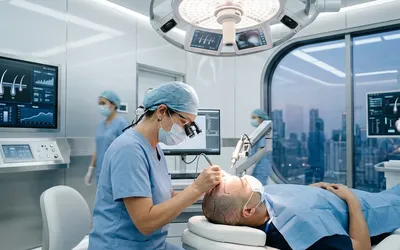
Hair Transplantation Innovations in 2026: DHI, Robotic Surgery, and Stem Cell Support
For decades, hair loss has been a significant source of anxiety and diminished self-confidence for millions of men and women worldwide. In the past, the solutions were either ineffective topical treatments or highly invasive, painful surgical procedures that left prominent linear scars across the back of the head. However, the landscape of hair restoration has undergone a massive technological revolution.
DHI hair transplant
Healtius
fue vs dhi
hair restoration abroad
hair transplant tourism
robotic hair transplant
stem cell hair loss treatment
unshaven hair transplant
Hair Transplant Tourism in 2026
Feb 13, 2026 · 4 min read

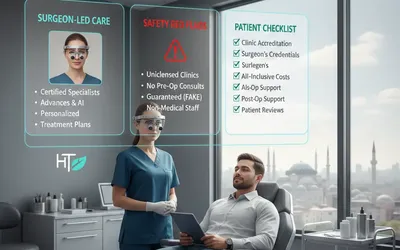
Hair Transplant Tourism in 2026: Surgeon-Led Care, Safety Red Flags, and a Patient Checklist

Hair transplant tourism is rising in 2026, but safety and long-term results depend heavily on surgeon-led care rather than marketing promises. This guide explains how to vet clinics abroad, understand real medical risks, spot red flags, and plan responsible aftercare before traveling for surgery.
FUE vs FUT
hair transplant abroad
medical tourism safety
surgeon-led hair transplant
blog_week2_6_navigators_1776976674316
Apr 23, 2026 · 5 min read

The Role of Patient Navigators in Health Tourism: Eliminating the Language and Cultural Barriers

Imagine navigating a sprawling, high-tech hospital to undergo a major surgical procedure. Now, imagine doing it in a country where you don't speak the language, you don't understand the local healthcare etiquette, and every medical term on your consent form is written in a foreign alphabet. This scenario is the primary reason many individuals hesitate to seek better or more affordable healthcare abroad, despite the obvious medical and financial benefits.
Healtius
cross-border healthcare
cultural barriers in medicine
health tourism coordinator
medical assistant abroad
medical tourism translation
medical travel support
patient navigator
blog1_quality_trust_1776890852657
Apr 23, 2026 · 8 min read

Quality and Trust in the New Era of Health Tourism: The Importance of International Accreditation

In recent years, health tourism has evolved from a mere search for affordable treatment into a strategic global movement aimed at securing high-quality, reliable healthcare. In the past, patients primarily planned cross-border trips to undergo medical procedures that were either too expensive or had long waiting times in their home countries. Today, however, "quality, safety, and transparency" have taken precedence over price.
Gemini_Generated_Image_bxlt64bxlt64bxlt
Feb 23, 2026 · 5 min read

NHS Costs from Medical Tourism Complications: What the 2026 Evidence Means for Patients

A 2026 UK evidence review found that complications from elective surgery abroad can cost the NHS up to nearly £20,000 per patient, highlighting the real clinical and financial impact of poor follow-up care. For patients, this underscores the importance of verified surgeons, clear aftercare plans, proper insurance, and realistic recovery timelines when considering medical tourism.
UK medical tourism safety
bariatric surgery abroad complications
cosmetic surgery overseas risks
elective surgery abroad risks
medical tourism complications NHS costs
travel health checklist
blog2_ai_telemedicine_1776890882458
Apr 23, 2026 · 6 min read

AI and Telemedicine: Pre-Treatment Digital Healthcare Processes Abroad
With the acceleration of technology, the healthcare sector is undergoing one of the greatest transformations in history. Not only diagnosis and treatment methods but also the ways patients access healthcare services are radically changing. Especially when it comes to health tourism, the uncertainties and anxieties experienced before traveling thousands of miles to a clinic are now being replaced by trust and transparency thanks to artificial intelligence (AI) and telemedicine applications.
Gemini_Generated_Image_imtq8gimtq8gimtq
Feb 22, 2026 · 5 min read

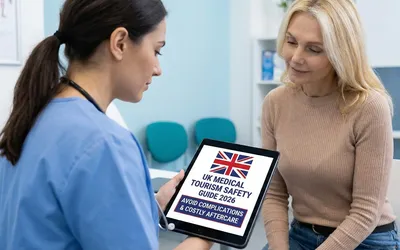
UK Medical Tourism Safety Guide 2026: Avoid Complications & Costly Aftercare

Medical tourism is rising in 2026, but UK evidence shows that complications treated after patients return home can be costly and complex. The biggest risks often come from poor follow-up care, not the surgery itself.Patients should choose surgeon-led clinics, secure written aftercare plans, confirm insurance coverage for complications, and budget beyond the package price.
UK patients surgery abroad complications
elective surgery abroad checklist
medical tourism aftercare
medical tourism safety 2026
medical travel insurance for surgery
post-op complications NHS cost
blog7_destinations_1776891080943
Apr 23, 2026 · 6 min read

Emerging Health Tourism Destinations: Quality and Affordable Alternatives
For many years, when global health tourism was mentioned, the routes that came to mind were quite limited. Mega economies like Mexico or Costa Rica for Americans, or the UK, Germany, or Switzerland for Europeans, were among the first choices. However, the exorbitant treatment costs and long waiting times in these traditional "Tier-1" metropolises pushed patients to look for new alternatives.
blog_week4_7_financing_1777647186140
May 9, 2026 · 5 min read

The Ultimate Guide to Financing Your Health Tourism Journey: Costs, Insurance, and Hidden Value

The primary catalyst for the global medical tourism boom is, undeniably, cost. Whether you are seeking a $20,000 dental reconstruction that costs $5,000 abroad, or a $150,000 heart bypass that costs $20,000 internationally, the financial arbitrage is impossible to ignore.
Healtius
all inclusive medical packages
cross border healthcare
finance surgery abroad
health tourism costs
hidden costs of medical tourism
medical complications insurance
medical travel insurance
blog_week2_7_bleisure_1776976727609
Apr 23, 2026 · 5 min read

Combining Business Travel with Health Tourism (Bleisure & Healthcare)

The modern professional landscape is defined by hyper-connectivity and constant motion. For executives, entrepreneurs, and digital nomads, traveling across borders for business is a routine part of life. However, this high-octane lifestyle often comes at a steep price: severe time poverty. Finding the time to prioritize personal health, schedule comprehensive check-ups, or undergo minor elective surgeries at home is frequently pushed to the bottom of the to-do list.
Healtius
VIP health tourism
bleisure healthcare
business travel health
corporate medical travel
dental tourism for executives
executive health check-up abroad
medical layover